Nitric Boost Ultra Ingredients: What's Inside and What the Science Says
Summary
- Nitric Boost Ultra contains eight ingredients: beet root powder, L-citrulline DL-malate, L-arginine, niacin, ginkgo biloba, horny goat weed, D-aspartic acid and dong quai.
- The first three are the core of the formula and the best supported by human research.
- The herbal extras have limited evidence and are the main source of drug interactions.
- Whether the formula works well depends on the amounts per scoop, so read the label against the research doses below.
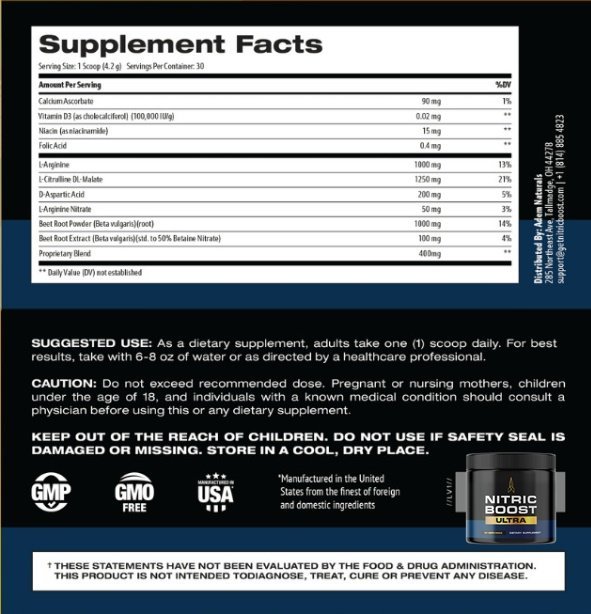
Ingredient list at a glance
| Ingredient | Per scoop (label) | Research range | Evidence |
|---|---|---|---|
| Beet root powder | [ ] | 300–500 mg nitrate | Good |
| L-Citrulline DL-Malate | [ ] | 3–6 g citrulline | Good |
| L-Arginine | [ ] | 3–6 g | Moderate |
| Niacin (B3) | [ ] | 16 mg daily need; 35 mg upper limit from supplements | Moderate |
| Ginkgo biloba | [ ] | 120–240 mg extract | Limited |
| Horny goat weed | [ ] | Not established | Limited |
| D-Aspartic acid | [ ] | About 3 g | Limited |
| Dong quai | [ ] | Not established | Limited |
"Evidence" is our rating of human research for each ingredient on its own for blood flow, exercise or male vitality. It does not mean Nitric Boost Ultra itself has been tested; we found no published trial of the finished product.
How the ingredients fit together
Your body makes nitric oxide in two ways. In the nitrate pathway, nitrate from vegetables such as beetroot is turned into nitrite by bacteria on your tongue and then into nitric oxide. In the arginine pathway, enzymes in the blood vessel lining build nitric oxide from the amino acid L-arginine. Nitric Boost Ultra supplies raw material for both, then adds a vitamin and several herbs. Here is what each one brings.
Beet root powder
Beetroot is one of the richest food sources of nitrate. A well-known meta-analysis found that inorganic nitrate and beetroot juice produced a modest drop in systolic blood pressure in adults, a sign of improved blood vessel relaxation. Sports research also shows that nitrate can help muscles use oxygen more efficiently during steady exercise. The catch is quantity: most studies used concentrated juice delivering about 300 to 500 mg of nitrate, while plain beet powder contains much less per gram. A few grams of powder gives some nitrate, but likely less than the trial doses unless the powder is concentrated. Beetroot pigments may turn urine or stools pink, which is harmless.
L-Citrulline DL-Malate
This is arguably the most important ingredient. Taken by mouth, L-arginine is largely broken down in the gut and liver before it reaches the blood vessels. L-citrulline avoids most of that breakdown and is turned into arginine in the kidneys. In a well-cited pharmacology study, oral citrulline raised blood arginine more effectively than the same dose of arginine. The "DL-malate" form binds citrulline to malic acid, which is involved in energy production; note that in citrulline malate, only part of the weight is citrulline itself (often about two thirds in a 2:1 product). Research typically uses 3 to 6 grams of citrulline per day.
L-Arginine
L-arginine is the direct starting material for nitric oxide synthase, the enzyme that makes nitric oxide. Because so much of an oral dose is lost before it is used, arginine alone has produced inconsistent results in healthy people. Combined with citrulline, it makes more sense: citrulline keeps arginine levels up over time while arginine provides a quick supply. Large doses can cause stomach upset. People with a history of heart attack should not take arginine without medical advice.
Niacin (vitamin B3)
Niacin is an essential vitamin. In its nicotinic acid form it widens small blood vessels in the skin, which causes the well-known "niacin flush": warmth, redness and tingling that usually fades within an hour. According to the NIH Office of Dietary Supplements, the tolerable upper intake level for adults from supplements is 35 mg per day, set mainly to avoid flushing. Very high doses, far above what is normally in a daily supplement, can affect the liver and blood sugar. If you take another product with niacin, add the amounts together.
Ginkgo biloba
Ginkgo leaf extract is one of the most studied herbs in the world, mostly for memory and circulation in the legs. NCCIH notes that large studies have not shown clear benefits for many of the conditions it is used for. Ginkgo may slightly reduce blood clotting, so it can raise bleeding risk in people taking blood thinners or before surgery. Studies typically use 120 to 240 mg of a standardized extract.
Horny goat weed (Epimedium)
A traditional Chinese herb used for male vitality. Its compound icariin inhibits the PDE5 enzyme in lab studies, which is the same target as some prescription drugs, but far more weakly. Most evidence comes from cell and animal research; reliable human trials are lacking. Because of the PDE5 link, it should not be combined with prescription PDE5 drugs or nitrate heart medicines without medical advice.
D-Aspartic acid
An amino acid involved in signaling between the brain and the testes. Early research reported short-term rises in testosterone in some men, but a controlled trial in resistance-trained men found no change in hormones, strength or body composition after 28 days. Our view: it is unlikely to matter much in this formula, and it is not a reliable testosterone booster.
Dong quai (Angelica sinensis)
A root used in traditional Chinese medicine, mainly for women's health. Evidence for circulation benefits in men is very limited. Memorial Sloan Kettering notes that dong quai may increase the effect of the blood thinner warfarin, and it may make the skin more sensitive to sunlight. It is the ingredient we find hardest to justify in a men's nitric oxide product.
Our take on the formula
The foundation is strong: beetroot plus citrulline plus arginine is a sensible, science-led combination. The five extras add variety but little proven benefit, and they bring most of the interaction warnings. The deciding factor is the amount of the three core ingredients per scoop. If the label shows several grams of citrulline and arginine combined, the formula is in a meaningful range. If those amounts are small, the product relies more on the herbs, and you might get more from a simple citrulline powder. Read our full Nitric Boost Ultra review for how this affects our overall score.
See the current label and packages on the seller's order page.
View Nitric Boost Ultra Offer Affiliate link.Ingredients FAQ
Does Nitric Boost Ultra contain caffeine?
No stimulants are listed among its ingredients.
Is it vegan?
The ingredients are plant-derived or made by fermentation, and the seller describes it as vegetarian-friendly. Strict vegans should check the "other ingredients" line on the label.
Which ingredient causes the warm, red skin?
That is the niacin flush. It is usually harmless and short-lived.
Which ingredients interact with medications?
Mainly ginkgo and dong quai (blood thinners), horny goat weed (PDE5 drugs, nitrates) and the nitric oxide ingredients as a group (blood pressure drugs). See our side effects guide.
References
- Siervo M, Lara J, Ogbonmwan I, Mathers JC. Inorganic nitrate and beetroot juice supplementation reduces blood pressure in adults: a systematic review and meta-analysis. J Nutr. 2013;143(6):818-826.
- Jones AM. Dietary nitrate supplementation and exercise performance. Sports Med. 2014;44(Suppl 1):S35-S45.
- Schwedhelm E, Maas R, Freese R, et al. Pharmacokinetic and pharmacodynamic properties of oral L-citrulline and L-arginine: impact on nitric oxide metabolism. Br J Clin Pharmacol. 2008;65(1):51-59.
- Willoughby DS, Leutholtz B. D-aspartic acid supplementation combined with 28 days of heavy resistance training has no effect on body composition, muscle strength, and serum hormones associated with the hypothalamo-pituitary-gonadal axis in resistance-trained men. Nutr Res. 2013;33(10):803-810.
- NIH Office of Dietary Supplements. Niacin – Fact Sheet for Health Professionals.
- NCCIH. Ginkgo.
- Memorial Sloan Kettering Cancer Center, About Herbs. Dong Quai.
Disclaimer: These statements have not been evaluated by the Food and Drug Administration. This product is not intended to diagnose, treat, cure, or prevent any disease. Content is for information only and is not medical advice.
This page contains affiliate links. We may earn a commission if you buy through them, at no extra cost to you. We are an independent guide, not the official website. Learn more.